
The European Space Agency’s Euclid telescope has released a sweeping new view of the cosmos, with a 500-gigapixel mosaic and data cataloguing more than 900 million galaxies. The first major release also includes tens of millions of quasar candidates and around 15,000 possible gravitational lenses, giving scientists new material to study how the universe is structured and how it has changed.
A 500-Gigapixel Mosaic Turns a Patch of Sky Into a Cosmic Panorama
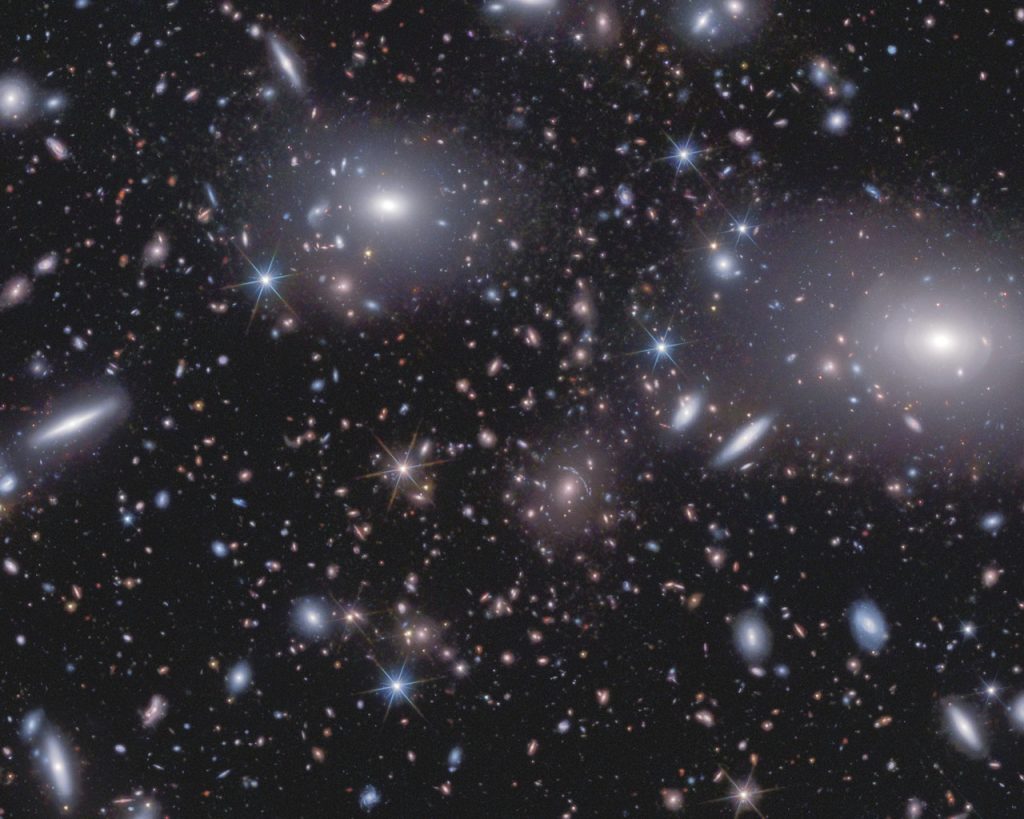
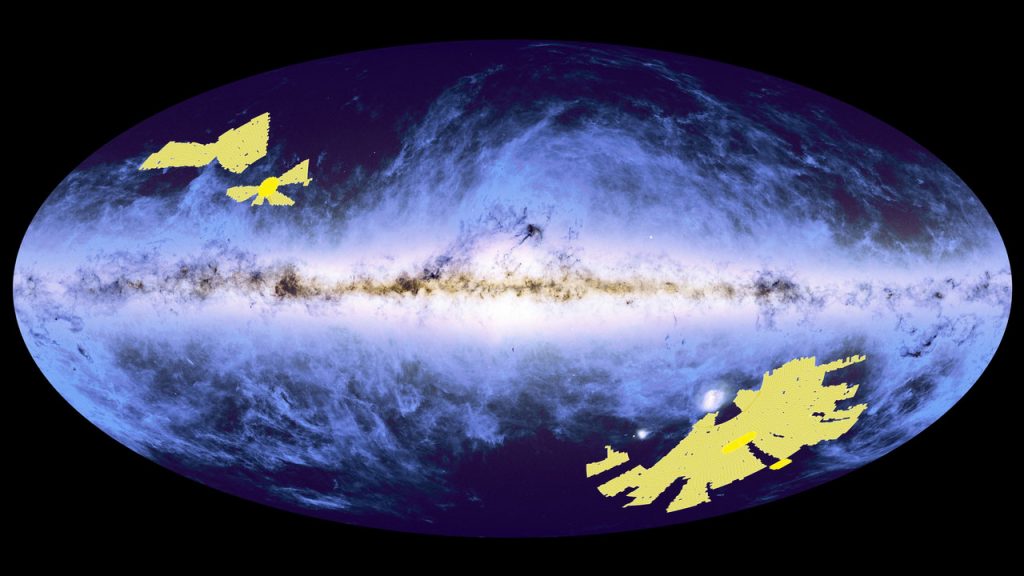
Euclid’s first major data release includes a 500-gigapixel mosaic assembled from about 13 months of observations. Its image captures a stretch of sky covering roughly 1,900 square degrees, an area about 9,500 times the apparent size of the full Moon. The mosaic is a vast overview: scientists can zoom from the broad sweep of the sky into detailed views of individual galaxies and other objects. This first release, called DR1-Foundation, gives researchers an early, substantial part of the survey data they will use to build a three-dimensional map of the cosmos.
More Than 900 Million Galaxies Make This a Vast Catalogue
The release identifies more than 900 million galaxies among the light from over a billion cosmic objects. It also includes more than 60 million quasar candidates. Quasars are exceptionally bright centers of distant galaxies, powered by material swirling around supermassive black holes. These figures describe an enormous catalogue for study, not a set of individually named or fully understood objects. By comparing galaxy shapes, distances and positions, researchers can study how galaxies formed and how large-scale structures changed over billions of years.
Gravitational Lenses Reveal How Mass Shapes Light
Euclid’s data include around 15,000 candidates for strong gravitational lensing. The effect happens when a massive object, often a foreground galaxy, bends the space around it and curves light traveling from a more distant galaxy behind it. In images, the background galaxy may appear stretched into arcs or rings, or show up in multiple distorted images. The catalogue’s objects are candidates that researchers can inspect and confirm. Studying them helps astronomers estimate how mass is distributed, including the invisible dark matter that contributes to a galaxy’s gravity.
Euclid’s Long Survey Will Probe the Universe’s Dark Side
The telescope’s larger mission is to map galaxies across cosmic time and investigate dark matter and dark energy. Dark matter does not give off light, but its gravity influences how galaxies move and how light bends around them. Dark energy is the name scientists give to whatever is driving the universe’s expansion to accelerate. Euclid can test ideas about both by measuring galaxy shapes and positions, then comparing those patterns across different distances. DR1-Foundation sets up that work; it does not answer these questions on its own. A more complete release, expected in mid-2027, will add higher-level analyses of galaxy clustering and weak gravitational lensing.