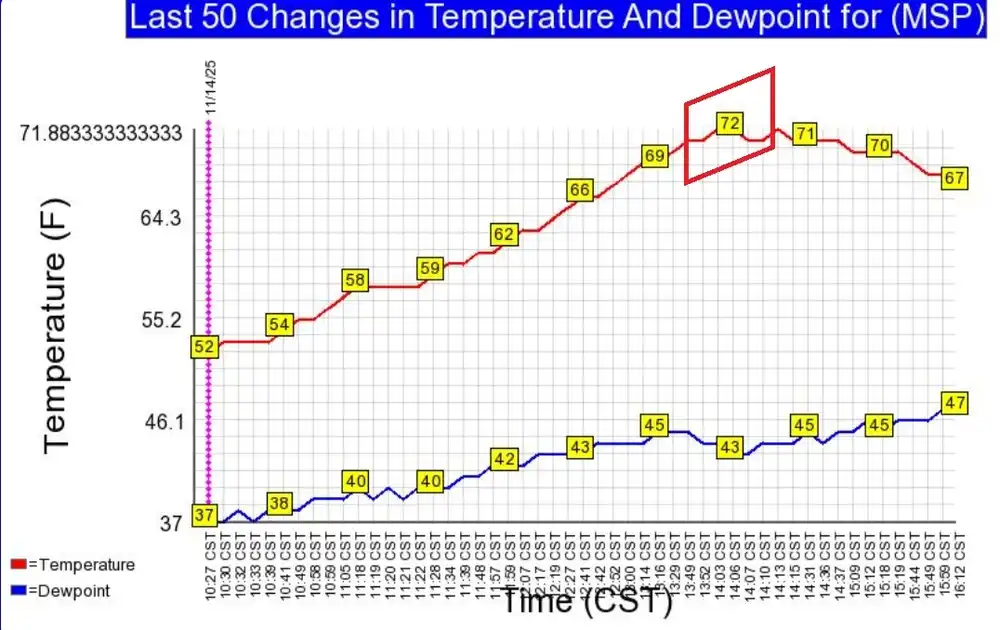

Minneapolis residents experienced an extraordinary November Friday as temperatures climbed to 72 degrees at Minneapolis-St. Paul International Airport, shattering multiple weather records and marking one of the longest meteorological autumns in Minnesota history. The balmy conditions broke the previous November 14 record of 71 degrees set back in 1990, but more remarkably established the latest date the Twin Cities has ever been this warm during fall season. While Minnesota has reached 71 degrees as late as November 17, 1953, Friday’s 72-degree reading represents uncharted territory for this point in autumn, with temperature records stretching back to 1873 providing historical context for just how unusual this warmth truly was.
Nearly 30 Degrees Above Normal Temperatures
Friday’s remarkable high soared 29 degrees above the normal November 14 temperature of 43 degrees for the Twin Cities, creating a stark contrast to typical mid-November conditions. The unseasonable warmth resulted from a dominant warm air mass that blanketed the central United States, bringing summer-like temperatures to a region typically preparing for winter’s arrival. Minnesota residents took full advantage of the extended fall weather, heading outdoors for activities more commonly associated with spring or early summer. Meteorologists attributed the unusual conditions to southerly winds and high pressure systems that allowed mild air to settle over the region, creating the perfect recipe for record-breaking temperatures.
Cold Front Brings 20-Degree Temperature Drop
A cold front moved through Minnesota overnight Friday into early Saturday morning, bringing a sharp correction to the unseasonable warmth. Saturday temperatures fell approximately 20 degrees compared to Friday, with highs in the 50s across southern Minnesota and 40s in northern regions, while the far north saw some areas struggle to reach the 30s. Gusty northwest winds up to 25 miles per hour accompanied the cooler air, making conditions feel considerably more brisk than the actual temperatures suggested. Despite the dramatic drop, Saturday’s readings still remained warmer than the normal high of 42 degrees for November 15, keeping the weekend slightly above seasonal averages even after the cold front passage.
Return To Seasonal Norms Expected Sunday
Sunday’s forecast calls for abundant sunshine and lighter winds as temperatures settle closer to typical November values for the Twin Cities region. The calmer conditions will provide a more comfortable day compared to Saturday’s blustery weather, though temperatures will remain notably cooler than Friday’s record-breaking heat. Looking ahead into next week, forecasters anticipate seasonably cool weather with afternoon highs mostly in the 40s across southern Minnesota and 30s in northern areas. A couple of minor systems could bring scattered rain or snow chances, though neither appears likely to produce significant precipitation accumulations at this time.
Colder Pattern Looms For Thanksgiving Week
Long range forecasts hint at a significant pattern change approaching as November transitions into December, with potentially much colder temperatures and possible snow arriving during Thanksgiving week. The Climate Prediction Center has identified increasing odds of below-normal temperatures across Minnesota and the Upper Midwest for late November into early December, marking a shift from the generally warm fall pattern that has dominated recent months. An arctic blast is expected to arrive later in the week, bringing highs potentially struggling to reach the upper 20s on Thanksgiving Day itself, with wind chills making it feel even colder in the teens. This abrupt change from record November warmth to bitter cold exemplifies Minnesota’s notorious weather volatility during the transition between seasons.