
Imagine sharing the aroma of freshly brewed coffee with someone halfway across the world without shipping a single bean. Researchers have developed Scentronic, an experimental technology that detects familiar smells and recreates them remotely using digital signals and a scent-generating device. The prototype could eventually bring new sensory experiences to virtual reality, online shopping, and digital communication, although several technical challenges remain.
Scentronic Can Detect an Aroma and Recreate It Somewhere Else
Imagine smelling freshly brewed coffee in one location and allowing someone thousands of miles away to experience a similar aroma. That is the idea behind Scentronic, an experimental technology developed by researchers from Ohio State University and Zhejiang Laboratory. The system connects an electronic nose that detects odors with a scent-generating device that recreates a corresponding smell at a remote location. When the electronic nose identifies a familiar aroma, the information is transmitted through an online platform to the receiving device, which releases a matching scent. The technology does not send actual smell molecules through the internet. Instead, it sends digital information that tells the receiving device which scent to produce using materials already available in its reservoirs. Researchers see this as a possible way to add smell to digital communication, alongside the images and sounds people already share. Although the prototype demonstrates that remote scent sharing is possible, it remains an early-stage system rather than a technology capable of reproducing every smell with complete accuracy.
The Technology Combines an Electronic Nose With Artificial Intelligence

Recreating a smell remotely begins with identifying what is present in the air, and that is where Scentronic’s electronic nose comes in. The researchers developed a sensing device equipped with an array of gas sensors that detect chemical compounds associated with different odors. These compounds, many of which are volatile organic compounds, contribute to the distinctive smells released by foods, drinks, and other materials. The sensor readings are converted into electrical signals, which a machine-learning model analyzes to classify the detected aroma. Once the system identifies a smell it has been trained to recognize, it sends the corresponding information to the receiving device over an internet connection. The receiving device then activates the appropriate scent-delivery channel. This combination of chemical sensing, artificial intelligence, wireless communication, and scent generation allows the process to operate without someone manually identifying the smell and selecting a fragrance. However, recognizing an odor category is not the same as identifying every chemical in a complex mixture. The system currently works with predefined scent categories, so it cannot yet capture and reproduce the complete chemical signature of any arbitrary smell.
The Prototype Currently Recognizes Five Familiar Scents

Coffee, cake, oranges, beer, and red wine form the initial scent collection used to demonstrate Scentronic’s capabilities. Researchers selected these familiar everyday aromas because they have different scent profiles and provide useful examples for testing the technology. The electronic nose was trained to recognize these categories, while the receiving device was equipped with corresponding scented liquids that could be released when a matching signal arrived. During testing, human volunteers correctly identified individual scents produced by the device approximately 73% of the time. When the system delivered combinations of two scents, participants identified them correctly about 71% of the time. These results suggest that the device can produce recognizable scent cues, although the experience does not always perfectly match the original aroma. Expanding the collection will require training the electronic nose to recognize additional odors and preparing suitable scented liquids for the receiving device. A much larger scent library could eventually support more applications, but the researchers have not demonstrated an unlimited range of reproducible smells. Complex aromas, particularly those containing many interacting chemical compounds, remain a significant technical challenge.
The Scent Generator Can Be Worn as a Wristband or Necklace
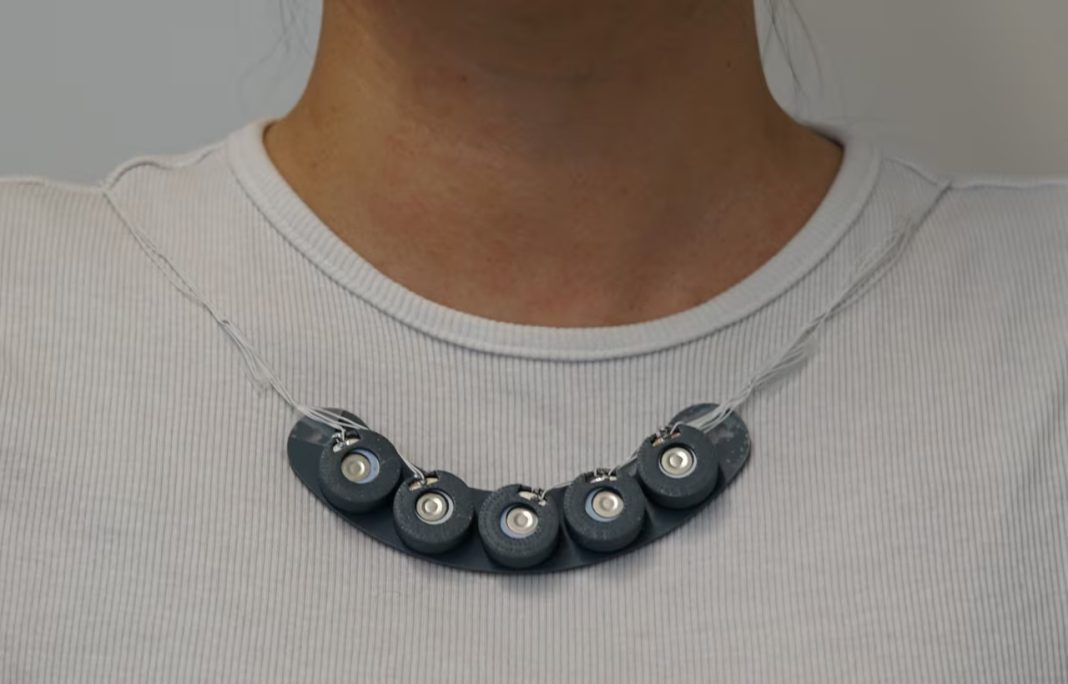
Unlike a conventional fragrance diffuser that fills a room with a general scent, Scentronic’s receiving device is designed to deliver a selected aroma directly to the user. The researchers developed several versions of the scent generator, including a wristband, a necklace, and a handheld device. These designs contain reservoirs of scented liquids and components that convert the liquid into a fine mist for the user to smell. The wristband uses two scent channels, while the necklace design accommodates five, allowing different scent combinations to be delivered. When the device receives the digital signal, it activates the appropriate channel to release the corresponding aroma. This approach could eventually make scent sharing more personal and portable, especially in applications involving virtual reality, mixed reality, or remote communication. However, the electronic nose itself is a separate device measuring roughly 15 centimeters in diameter, so the entire system is not yet as compact as a smartphone. The wearable scent generators also depend on having the right scented liquids available. Before the technology becomes practical for everyday use, researchers will need to improve its portability, refillability, durability, and ability to deliver a wider variety of smells.
The Technology Could Make Online Shopping and Virtual Reality More Immersive

Digital experiences could become more engaging if people were able to smell what they see on a screen. Scentronic offers a possible way to introduce that extra sensory dimension by linking digital content with a physical scent generator. In online shopping, a future version might allow customers to sample selected fragrances remotely rather than relying entirely on descriptions or product images. Virtual and augmented reality experiences could also benefit, with a corresponding aroma accompanying a virtual café, garden, meal, or other environment. The researchers additionally demonstrated a prototype cup that combines scent delivery with a system for dispensing flavored liquids. Used alongside a mixed-reality headset, the setup allows a virtual drink selection to trigger a corresponding sensory experience involving smell and taste. Other possible applications include sharing the aroma of a meal with distant friends or family and developing tools for controlled smell testing in healthcare research. These uses remain possibilities rather than established consumer services. The current system has not demonstrated the ability to transmit every complex food aroma, recreate the exact smell of a restaurant meal, or reproduce any perfume on demand. Practical applications will depend on expanding its scent library and improving how accurately the generated aromas match their intended targets.