
Some shops sell products. Others sell a way of looking at the world.
Ink-ish, a newly opened magazine store in St. Paul, belongs firmly in the second category. In a media landscape dominated by feeds, swipes, and endless refreshes, this small storefront makes a quietly radical promise: slow down, pick something up, and read with intention.
A Store Built for the Printed Page
Ink-ish opened over the weekend in St. Paul and immediately stood out because it is not simply a bookstore with a magazine rack tucked near the register. It is a shop devoted specifically to independent, hard-to-find magazines, a category that rarely gets its own dedicated retail space in American cities. According to Axios Twin Cities, the store sits next to Stepwise Coffee on Randolph Avenue, giving it the kind of neighborhood adjacency that can turn an errand into an hour-long browse.
That location matters. Stepwise Coffee lists its café at 893 Randolph Ave., while Ink-ish is at 895 Randolph Ave., creating a natural pairing of coffee and print that feels almost designed for lingering. The rhythm is easy to imagine: espresso next door, a stack of magazines in hand, and an unhurried conversation about design, politics, food, or culture. Retail succeeds when it understands not just what people buy, but how they want to spend time.
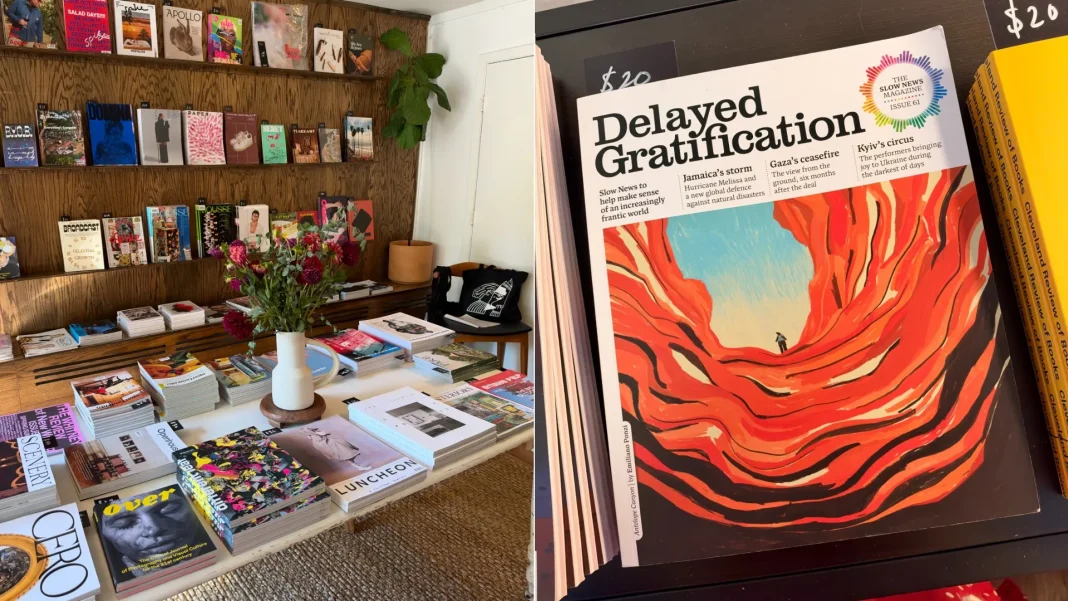
Owner Bobby Maher has stocked at least 75 titles, according to Axios, with a range that moves across architecture, food, culture, creative writing, and long-form journalism. Prices generally run from $10 to $40, which positions the magazines less as disposable reading material and more as collectible cultural objects. That is an important distinction. Independent magazines are often printed on premium paper, art-directed with extraordinary care, and edited for readers who want depth instead of churn.
The titles themselves tell the story of what Ink-ish is trying to do. Among the standouts named by Axios are Delayed Gratification, the London-based “slow news” magazine; Different Leaf, which covers art, culture, and cannabis; and Mortise & Tenon, a twice-yearly publication devoted to hand tools and traditional woodworking. This is not inventory designed for impulse checkout lanes. It is a curated argument that magazines can still function as vessels of obsession, expertise, and beauty.
Why a Magazine Shop Feels So Unusual — and So Timely
The opening of a magazine-only shop sounds almost defiant in 2026, and that is precisely why it feels significant. For years, magazines were treated as casualties of digital migration, squeezed by advertising losses, thinner distribution, and changing habits. Yet print never disappeared; it changed character. What was once a mass product increasingly became a specialty object, cherished not for speed but for permanence, design, and editorial distinctiveness.
That broader context helps explain why a shop like Ink-ish makes cultural sense now. Axios has reported on a recent print resurgence, noting that brands such as Nylon returned to physical editions and that Complex revived its flagship magazine as part of a wider effort to use print as both product and statement. These moves are not nostalgia for nostalgia’s sake. They reflect a growing understanding that physical media offers something digital abundance cannot: scarcity, texture, and a sense of occasion.
At the same time, the larger publishing ecosystem remains substantial. The Association of American Publishers reported that the U.S. publishing industry generated $32.5 billion in aggregate revenue in calendar year 2024, up 4.1% from 2023. That figure covers books and course materials rather than indie magazines specifically, but it underscores a larger truth: print culture is not dead. It is evolving, fragmenting, and in some corners becoming more intentional and premium.
Even the language around media has shifted. Readers are increasingly drawn to formats that promise deliberation over distraction. The appeal of a magazine like Delayed Gratification, which explicitly brands itself around “slow news,” captures this mood perfectly. In an era when information arrives instantly and often incompletely, a beautifully made quarterly or biannual publication can feel less like old media than like a corrective. Ink-ish steps into that mood with precision, offering a retail model built on curation rather than volume.
St. Paul as the Right Place for a Niche Idea
Not every city could support a store like this, but St. Paul may be especially well suited to it. The city has long sustained a strong independent literary and retail culture, one rooted in neighborhood identity and a willingness to support smaller, mission-driven shops. Recent years have brought continued energy to that ecosystem, from the opening of Acorn Bookshop in Milton Square to the expansion of other independent bookstores and creative retail concepts across the Twin Cities.
That matters because Ink-ish is not arriving into a vacuum. It is joining a regional culture that already values browsing, local ownership, and spaces with personality. Mpls.St.Paul Magazine has repeatedly documented how independent shops in the Twin Cities thrive by becoming community anchors rather than mere storefronts. That same pattern applies here. A magazine shop cannot compete with an algorithm on convenience, so it competes on atmosphere, expertise, and the pleasures of serendipity.
There is also something deeply fitting about the St. Paul setting itself. This is a city that often rewards understatement over spectacle, and Ink-ish feels aligned with that temperament. A small space full of uncommon titles invites a quieter kind of cultural participation. It asks visitors not just what they want to consume, but what they want to dwell in. For readers exhausted by the frictionless sameness of online discovery, that is a powerful proposition.
Then there is the neighborhood scale of Randolph Avenue. A destination like Ink-ish benefits from pedestrian curiosity and repeat local traffic more than from tourist footfall alone. Being open Saturdays and Sundays from 9 a.m. to 3 p.m., as Axios reports, reinforces the idea that this is a weekend ritual space. It is the kind of shop people fold into their existing routines until, over time, it becomes one of the reasons a neighborhood feels like itself.
What Independent Magazines Offer That Screens Often Cannot
To understand why Ink-ish matters, it helps to understand what independent magazines actually do well. They specialize in depth, but also in form. Their power lies not only in the stories they tell, but in sequencing, typography, photography, paper stock, and cover design. A good indie magazine does not merely deliver information; it stages an experience. That experience begins before the first sentence and lingers after the last page.
In that sense, the shop is selling editorial vision as much as printed matter. A title focused on architecture might reveal as much through layout and negative space as through text. A food quarterly may function partly as criticism, partly as visual art object, partly as anthropological record. A publication about woodworking, cannabis, or creative writing can become a portal into subcultures that mainstream retail almost never represents with care. Ink-ish gives those worlds shelf space and legitimacy.
There is also the matter of trust. On a screen, every piece of content competes at once, flattened into tabs and thumbnails. In print, selection is more visible. Readers can sense what editors chose to include, what they left out, and how a publication wants to be held and revisited. That editorial coherence is one reason niche print objects retain devoted audiences. They feel made, not merely posted.
And then there is attention itself, now one of the most contested resources in modern life. Browsing a magazine store is a rare invitation to pay attention without being tracked, notified, or interrupted. The object in your hand is the whole thing. No pop-ups, no autoplay, no recommendation engine insisting on the next click. Ink-ish is small, but the philosophy embedded in it is expansive: reading can still be tactile, bounded, and absorbing. For many people, that now feels less ordinary than luxurious.
More Than a Shop, a Bet on Cultural Memory
Ink-ish is easy to describe as a retail opening, but that understates what it represents. It is better understood as a bet: that enough readers still want media they can collect, display, revisit, and talk about in person. That bet may seem modest measured against the scale of digital publishing, yet culturally it lands with force. Dedicated spaces shape habits. They tell people that a format deserves attention, and that browsing itself has value.
The shop also restores visibility to magazines as objects of independent production. In many mainstream outlets, magazine sections have shrunk or disappeared, leaving readers to encounter periodicals mostly through subscriptions or occasional boutique displays. A store devoted to the form reverses that disappearance. It says magazines are not an afterthought to books, gifts, or stationery. They are worthy of their own shelves, their own audience, and their own retail language.
There is precedent for this kind of confidence. Axios has noted similar magazine-shop openings elsewhere, including Detroit, where a store called Periodicals embraced the tactile pleasure of print in the digital age. Ink-ish brings that sensibility to the Twin Cities, but with a local inflection: neighborhood-scaled, carefully curated, and rooted in St. Paul’s independent spirit. In doing so, it gives the region something both old-fashioned and newly rare.
Ultimately, the significance of Ink-ish lies in the kind of future it imagines. Not a future where print replaces digital, but one where physical reading survives because it offers different rewards. The shop’s inventory, hours, and scale all suggest intimacy rather than mass reach. That may be exactly the point. In an age defined by infinite distribution, Ink-ish makes a persuasive case for the finite: a few shelves, a few dozen titles, a few quiet hours on a weekend morning, and the feeling that what you discover there might stay with you longer than anything you scrolled past all week.