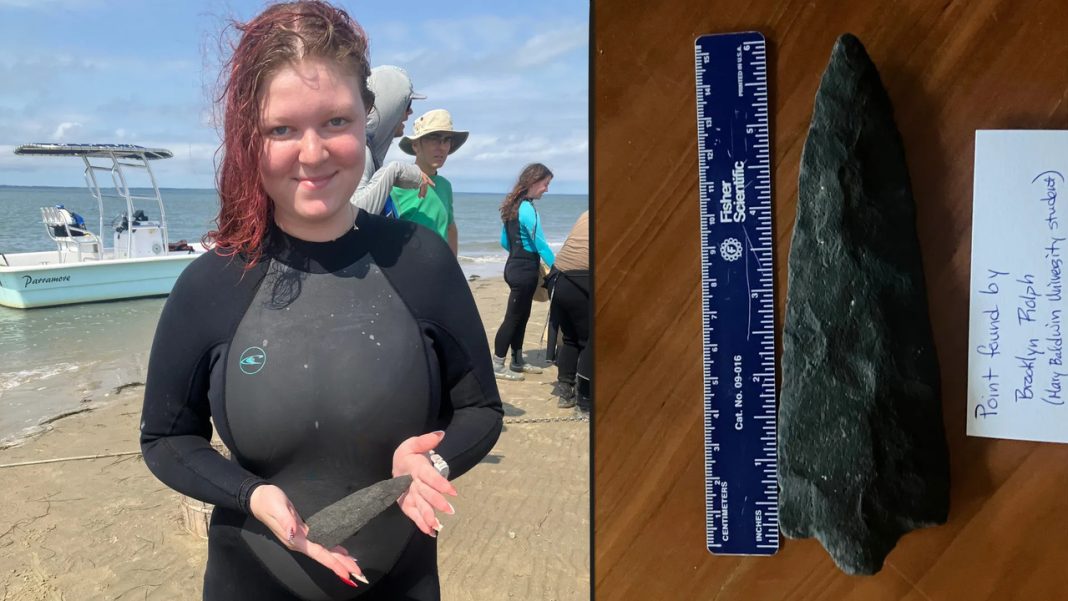

A routine search for shark teeth turned into an extraordinary archaeological discovery for a Virginia college student exploring the Eastern Shore. Brooklyn Rolph, a biology student at Mary Baldwin University, spotted an unusual stone object near an inlet on Wreck Island during a university field trip. What initially looked like an interesting beach find turned out to be a rare Indigenous spearpoint estimated to be between 3,000 and 4,500 years old. Measuring approximately six inches, the artifact belongs to a prehistoric tool type known as a Lehigh/Koens-Crispin point. Its discovery offers a fascinating glimpse into the lives and technologies of Indigenous communities that inhabited the region thousands of years before modern Virginia took shape.
A Routine Shark Tooth Hunt Turned Into an Extraordinary Archaeological Discovery
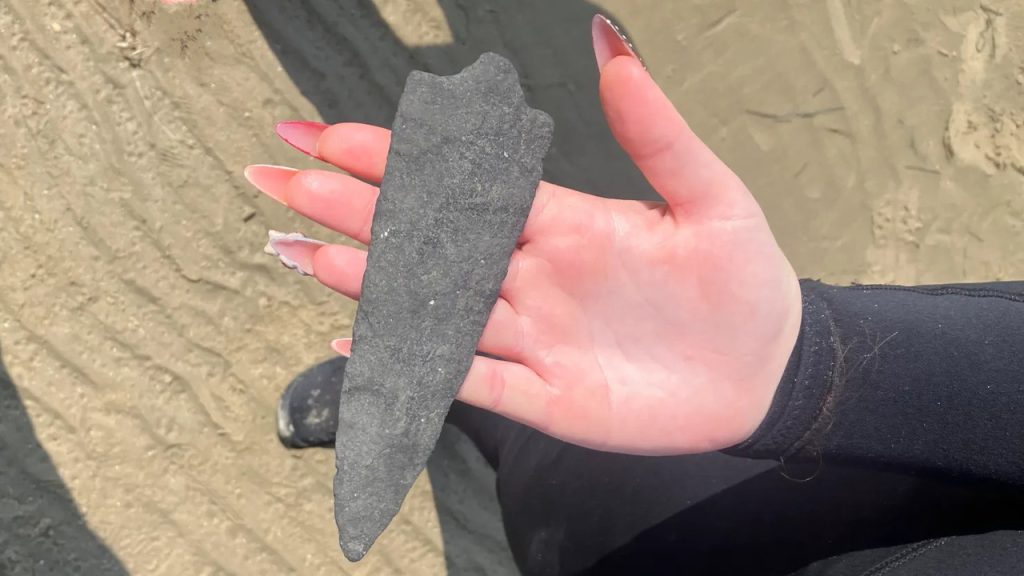
Sometimes an ordinary afternoon outdoors can lead to a discovery that completely changes the day. That was the case for Brooklyn Rolph, a biology student at Mary Baldwin University in Virginia, who stumbled upon an ancient stone spearpoint while looking for shark teeth. The discovery happened on September 21, 2026, during the final day of a four-day ecology field trip to Virginia’s Eastern Shore. Rolph had joined her classmates to study coastal ecosystems, including the plants and animals living around the region’s barrier islands. After spending the morning collecting specimens and working in a seagrass bed, the students had a short opportunity to explore a nearby island. Rolph noticed something unusual among the shells near an inlet and quickly realized it was not an ordinary beach find. The object turned out to be a stone spearpoint estimated to be between 3,000 and 4,500 years old. She immediately ran to her professors, who were astonished by what she had discovered. The unexpected find transformed a routine university field trip into an important archaeological moment, connecting a modern student with the people who inhabited the region thousands of years ago.
The Artifact Is a Rare Lehigh/Koens-Crispin Spearpoint
What makes Rolph’s discovery particularly interesting is that the object belongs to a recognizable category of prehistoric stone tools known as a Lehigh/Koens-Crispin point. Sometimes referred to as a broadspear, this type of artifact was made by Indigenous communities along the eastern coast of North America during the Late Archaic period, roughly 4,500 to 3,000 years ago. These points are generally characterized by their broad, carefully shaped stone construction, which distinguished them from many smaller projectile points used for hunting. Although their precise functions could vary, archaeologists believe broadspears may have been attached to wooden shafts and used as hunting weapons. Some may also have served as knives or cutting implements. The artifact Rolph discovered measures approximately six inches, making it a substantial example of this prehistoric tool type. Its identification is important because stone tools can provide valuable information about the technologies, practical skills and daily activities of Indigenous communities before written historical records. The condition of the spearpoint has also attracted attention. According to Rolph, the archaeologist who examined it remarked that he had never seen one in such good condition. Further examination by specialists could help establish more about its construction, material and historical context.
The Spearpoint Could Be Between 3,000 and 4,500 Years Old
An object that has remained buried or hidden for thousands of years naturally raises questions about when it was made and who might have used it. The spearpoint found by Rolph is estimated to date between 3,000 and 4,500 years ago, placing it within the Late Archaic period of North American prehistory. This was a significant period in the history of Indigenous communities, when people throughout the eastern United States developed sophisticated stone tools and maintained extensive relationships with their surrounding environments. Hunting, fishing, gathering and the use of coastal resources were important parts of life for many communities. The age estimate is based primarily on the artifact’s recognizable shape and its classification as a Lehigh/Koens-Crispin point. This is not the same as obtaining an exact scientific date through laboratory testing. Rather, archaeologists compare the object’s design with similar artifacts recovered from other locations and archaeological contexts. The estimated age range therefore reflects the period during which this particular tool style was used. Additional research could provide more information about the stone itself and its possible origins. Even without an exact date, the discovery offers a fascinating glimpse into the region’s Indigenous history long before European colonization.
The Six-Inch Artifact Was Found on Virginia’s Eastern Shore

The location of an archaeological discovery can be just as important as the object itself. Rolph found the spearpoint on Wreck Island, a barrier island along Virginia’s Eastern Shore, during a university ecology field trip connected to the University of Virginia’s Anheuser-Busch Coastal Research Center. The surrounding region is part of the Delmarva Peninsula, which includes Delaware and portions of Maryland and Virginia. Barrier islands are constantly shaped by waves, tides, currents and changing shorelines, making them particularly interesting environments for studying coastal ecosystems and the movement of natural materials. The discovery took place near an inlet in the intertidal zone, where the shoreline is alternately exposed and covered by water as the tides change. Rolph initially noticed the dark stone among the lighter oyster and clam shells scattered across the area. Its unusual appearance caught her attention because she was already looking for small, pointed objects such as shark teeth. The spearpoint’s presence in this coastal setting also raises interesting questions about how it reached the location where it was discovered. However, its exact history and original context have not yet been established. Further archaeological examination may help researchers understand more about its relationship to Indigenous activity along Virginia’s coast.