
Astronomers may have uncovered another major piece of the solar system’s distant puzzle. A newly identified object beyond Neptune, provisionally named 2026 ED138, is attracting attention because its estimated size could make it a potential sixth dwarf planet. Discovered through observations from the Vera C. Rubin Observatory, the icy object has an unusual tilted orbit and remained hidden among millions of background stars. Although researchers still need additional observations to confirm its physical characteristics and official classification, the discovery offers an exciting opportunity to learn more about the mysterious region beyond Pluto.
A New Dwarf Planet Candidate Has Been Identified Beyond Pluto
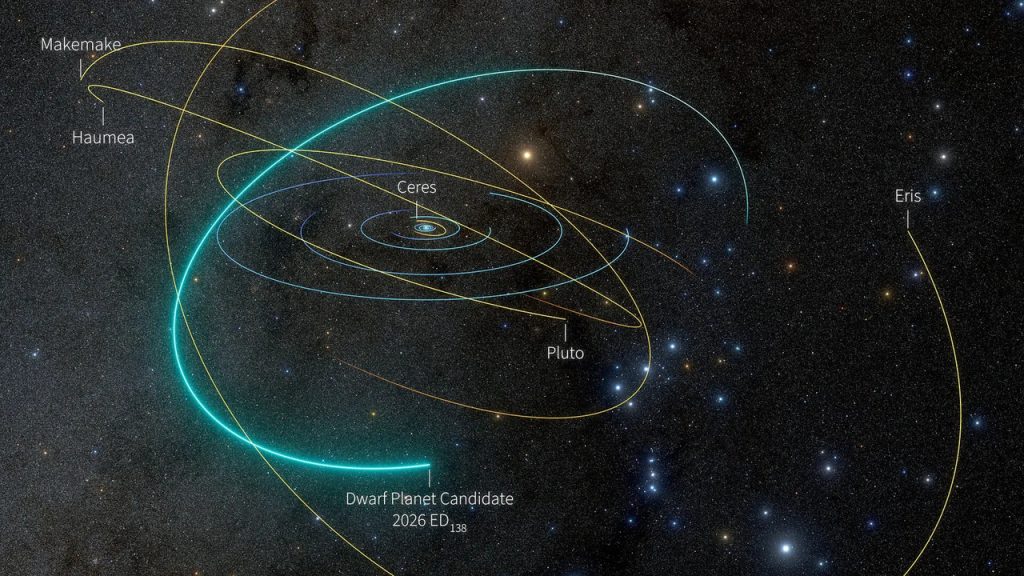
The distant reaches of our solar system may be home to another surprisingly large world. Astronomers working with data from the NSF-DOE Vera C. Rubin Observatory have identified an object beyond Neptune that could become the sixth officially recognized dwarf planet. Provisionally designated 2026 ED138, the icy object is located farther from the Sun than Pluto and appears unusually bright for something in that remote region. Its discovery is particularly interesting because relatively few large objects have been identified beyond Neptune, despite the presence of thousands of smaller icy bodies in the Kuiper Belt. Researchers believe ED138 could be large enough for its own gravity to pull it into a rounded shape, one of the essential requirements for dwarf planet classification. However, its exact size and physical characteristics still need to be established through additional observations. If astronomers confirm its status, it would join Pluto, Ceres, Eris, Haumea and Makemake in the International Astronomical Union’s recognized dwarf planet category.
The Object Has Been Given the Provisional Name 2026 ED138

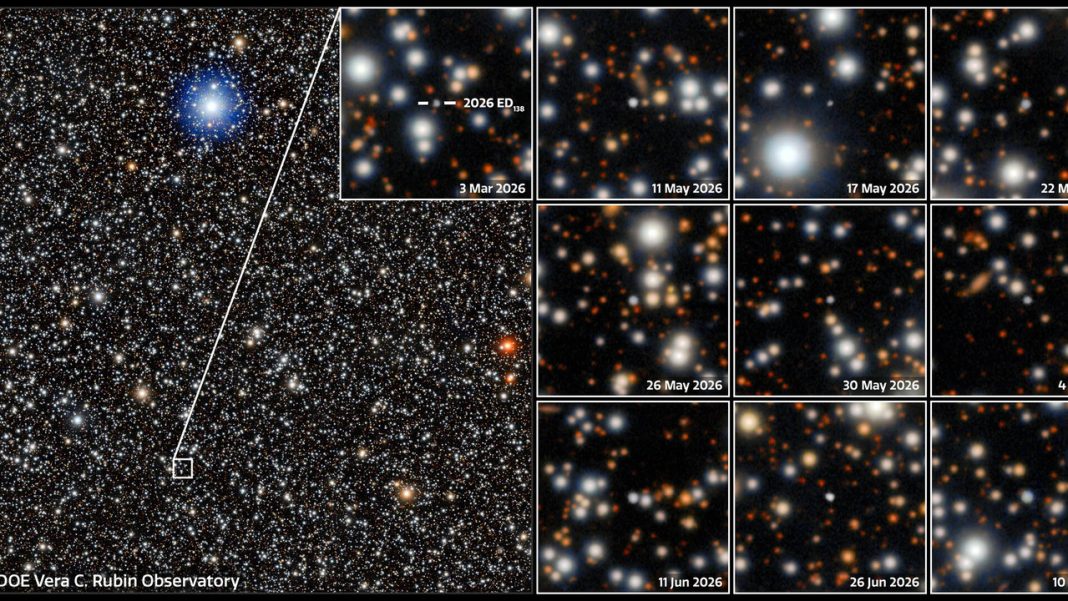
Every newly identified object in the solar system needs a designation that allows astronomers to track it while its characteristics and orbit are investigated. This particular discovery has received the provisional designation 2026 ED138, which distinguishes it from the thousands of other known objects moving around the Sun. The discovery was made by Matthew Holman, an astrophysicist at the Center for Astrophysics | Harvard & Smithsonian, who was analyzing observations collected by the Vera C. Rubin Observatory. He used specialized software developed with colleague Kevin Napier to connect observations of moving objects across enormous astronomical datasets. The discovery emerged on October 13, 2026, when Holman identified an unusually bright object in the observatory’s earlier data. Additional investigation confirmed that the detections belonged to the same moving body. The International Astronomical Union’s Minor Planet Center subsequently announced the discovery, giving researchers a formal designation to use while studying its orbit and physical properties. The name remains provisional, and further observations will help astronomers establish more about this distant world.
Scientists Estimate Its Diameter Could Reach 1,500 Kilometers

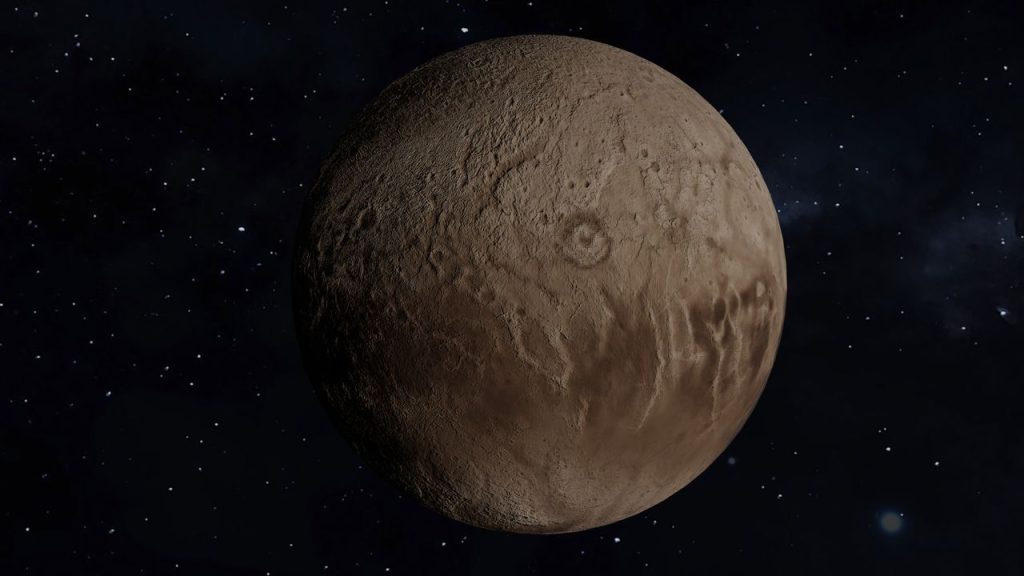
One reason astronomers are particularly interested in ED138 is its estimated size. Based on its brightness, distance from the Sun and possible surface reflectivity, researchers currently place its diameter somewhere between approximately 600 and 1,500 kilometers. That is a substantial range, but even the lower estimate makes it an interesting object among the known population beyond Neptune. For comparison, Pluto measures approximately 2,377 kilometers across, while Ceres, the smallest officially recognized dwarf planet, has a diameter of about 940 kilometers. ED138 could therefore be comparable in size to Ceres or considerably larger, depending on how reflective its surface actually is. Brightness alone cannot provide an exact measurement because a smaller object with a highly reflective surface can appear similar to a larger object with a darker surface. Astronomers need additional infrared observations to better understand how much sunlight the object reflects and how much heat it emits. These measurements should help narrow down its actual dimensions and determine whether its mass is sufficient for gravity to shape it into a nearly spherical body.
Its Unusual Orbit Is Tilted Nearly 25 Degrees
Unlike the planets, which generally travel around the Sun along relatively similar orbital planes, ED138 follows a noticeably tilted path. Researchers estimate that its orbit is inclined by approximately 25 degrees relative to the plane of the solar system. This unusual trajectory places it in a category known as a hot-classical trans-Neptunian object. Its orbital characteristics are important because they may reveal something about the gravitational forces that shaped the outer solar system billions of years ago. Scientists believe interactions with Neptune could have disturbed ED138 from its original orbit, leaving it on a more inclined path. Neptune’s gravity has played an important role in shaping the distribution of icy objects beyond its orbit, scattering some bodies and influencing the paths of others. ED138 currently sits approximately 46 astronomical units from the Sun, meaning it is about 46 times farther from the Sun than Earth is. Pluto, by comparison, has an average orbital distance of approximately 40 astronomical units. Studying ED138’s movement could therefore help researchers better understand how distant objects evolved and how the giant planets influenced the architecture of the solar system.
The Object Remained Hidden Among Millions of Milky Way Stars
Finding a large object in space does not necessarily mean it will be easy to spot. ED138 remained undiscovered partly because it occupies a particularly crowded region of the sky near the plane of the Milky Way. This area contains millions of background stars, making it difficult for many telescopes to distinguish faint moving objects from the surrounding points of light. Even a relatively large body can become difficult to identify when it appears against such a dense stellar background. The Vera C. Rubin Observatory has an advantage in this situation because it repeatedly photographs large sections of the southern sky and uses powerful computer algorithms to identify objects that change position or brightness. Its search software can compare billions of individual detections and connect observations that belong to the same moving object. Researchers also examined older images from the Dark Energy Camera on the Victor M. Blanco 4-meter Telescope in Chile, finding earlier observations of ED138 dating back to 2016. Combined with the Rubin observations, these records allowed astronomers to reconstruct more than a decade of its orbital movement. This process, known as precovery, demonstrates how older astronomical images can become valuable once scientists know exactly where to look.
Further Observations Are Needed Before It Can Become an Official Dwarf Planet
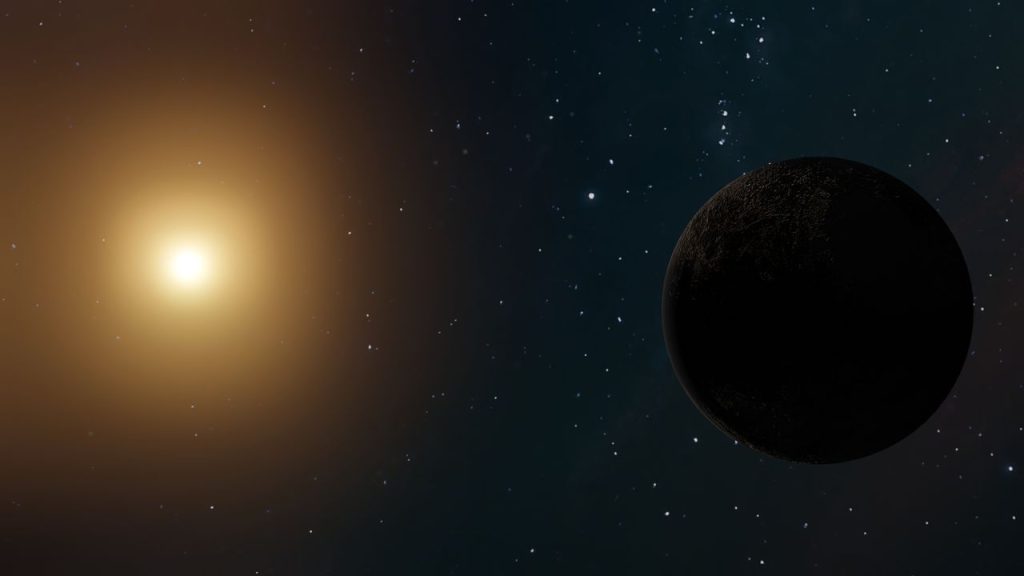
Although ED138 has attracted considerable attention, astronomers still need more evidence before it can officially join the dwarf planet category. Under the International Astronomical Union’s definition, a dwarf planet must orbit the Sun, have enough mass for its own gravity to pull it into a nearly round shape, and not have cleared the neighborhood around its orbit of other objects. ED138 already satisfies the orbital requirement, but researchers need better information about its size, density and physical characteristics to establish whether it meets the remaining conditions. Infrared observations are particularly important because they can help scientists estimate its surface temperature and reflectivity, producing a more reliable measurement of its diameter. Researchers are also interested in studying its surface composition, which could provide clues about the icy materials found throughout the Kuiper Belt. The discovery is an early example of what the Vera C. Rubin Observatory could accomplish during its planned decade-long survey of the southern sky. As the observatory continues collecting images, astronomers expect to identify many more distant solar system objects, potentially uncovering additional dwarf planet candidates that previous surveys missed.