


Spanish Prime Minister Pedro Sánchez faces a major political test on Sunday, November 29, as voters head to the polls in a snap general election that could end eight years of Socialist-led government and bring the far right into national power.
The election comes amid a worsening housing affordability crisis, corruption scandals involving Sánchez’s political allies and growing public dissatisfaction over living costs despite Spain’s strong economic growth.
Sánchez called the early election in October after his governing coalition failed to secure parliamentary support for emergency measures aimed at addressing the country’s housing crisis.
Opposition leads polls ahead of Spain’s general election

The center-right People’s Party (PP), led by Alberto Núñez Feijóo, remains ahead of Sánchez’s Spanish Socialist Workers’ Party (PSOE) in most opinion polls.
An updated polling average published by Polling Forecast on November 27 placed the PP at 30.9%, followed by the PSOE at 28.9% and the far-right Vox party at 18.1%.
Although Sánchez has narrowed the gap during the election campaign, forming another left-wing government could prove difficult.
A party or coalition needs at least 176 seats in Spain’s 350-seat lower house to secure an absolute majority. A potential alliance between the PP and Vox could give both parties enough seats to form a government.
Such a coalition would mark the far right’s first participation in Spain’s national government since the country’s transition to democracy following Francisco Franco’s death in 1975.
Feijóo has focused his campaign on government accountability, public services and the administration’s handling of two major railway accidents this year. Vox, led by Santiago Abascal, has made stricter immigration policies a central part of its campaign.
Housing crisis and corruption scandals put pressure on Sánchez
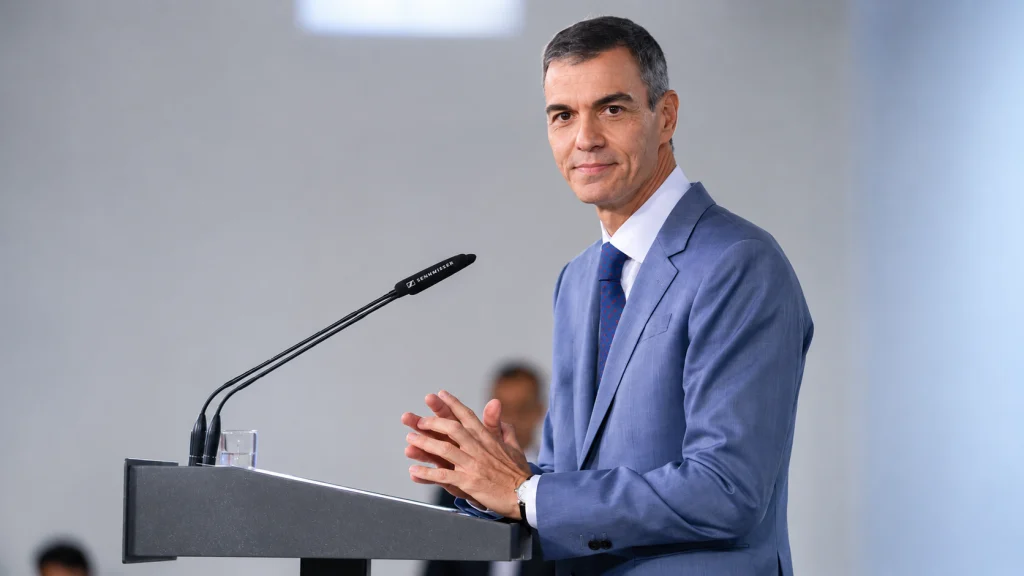
Spain has experienced considerable economic growth under Sánchez, with unemployment falling from 15% to 10% since he took office in 2018. The monthly minimum wage has also increased from €735 to €1,221.
However, rising living costs and housing shortages have placed many households under financial pressure. According to property platform Idealista, rents across Spain have increased by 44% since Sánchez became prime minister.
His government has also faced several corruption controversies. Former Transport Minister José Luis Ábalos was sentenced to 24 years in prison in June on corruption charges.
Sánchez’s wife, Begoña Gómez, has been ordered to stand trial over alleged influence peddling and misappropriation of public funds. She denies the charges.
Sánchez has denied personal wrongdoing and defended his government’s response to corruption. In a September interview with CNN, he argued that some of the allegations were politically motivated efforts by the opposition to remove him from office.
Sánchez’s disputes with Trump add international significance
The election could also have implications for Spain’s relationship with the United States.
Sánchez has repeatedly clashed with President Donald Trump over NATO defense spending and US military operations against Iran. His government refused to allow Washington to use jointly operated military bases in Spain for direct strikes on Iran and opposed demands to increase defense spending to 5% of GDP.
While those positions have raised Sánchez’s international profile, Sunday’s election will test whether Spanish voters believe his government deserves another term.
The outcome will determine whether Sánchez can retain power or whether Spain moves toward a conservative-led government with the support of Vox.