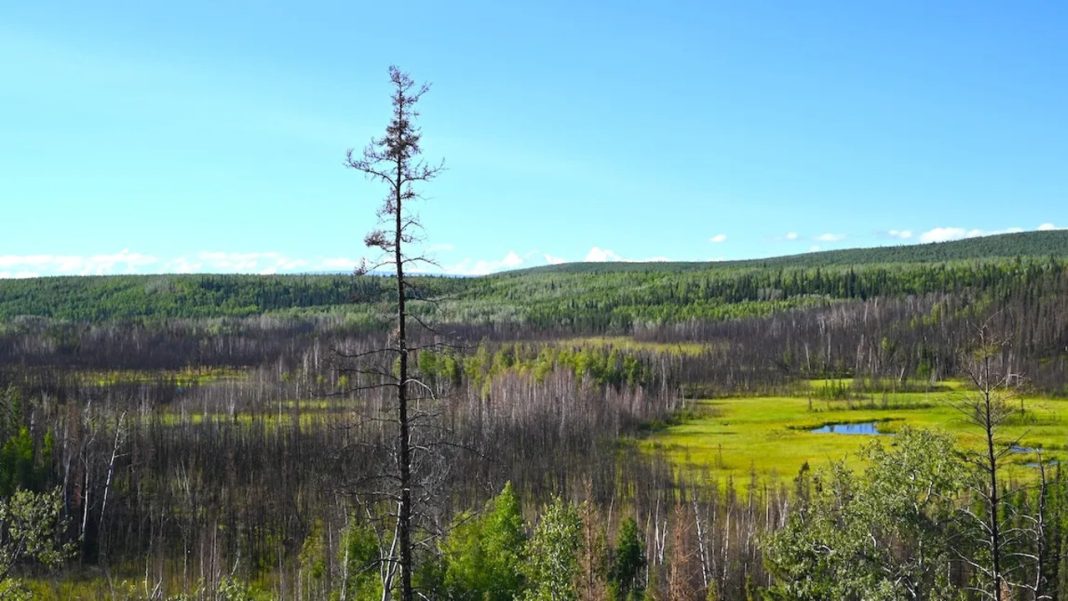

Nearly 14,000 years ago, people were already finding ways to make a home in the unforgiving landscape of Ice Age Alaska. Now, archaeologists have uncovered evidence of a remarkably old campsite that may contain the earliest known dwelling in the Americas. From traces of a possible shelter to bone needles, unusual stone tools and an intriguing animal discovery, the finds offer a rare glimpse into how these early inhabitants lived, prepared food and adapted to their surroundings. Here are six clues that make this ancient site so remarkable.
A 13,800-Year-Old Site May Hold the Oldest Known Dwelling in the Americas

Long before permanent houses and established settlements became common, people were already finding ways to make unfamiliar landscapes feel like home. In interior Alaska, archaeologists have uncovered evidence of an ancient base camp called Shég’ Xdaltth’í’, an Alaska Native Athabascan name meaning “They Were There.” Located about 34 miles southeast of Fairbanks, the site dates back approximately 13,800 years. Researchers found tens of thousands of archaeological specimens, including stone tools, animal bones and evidence of a possible dwelling. What makes the discovery particularly significant is the combination of structural remains and everyday objects, which suggests this was more than a brief stop during a hunting trip. The researchers believe people returned to the area over an extended period, offering a rare glimpse into how some of the earliest inhabitants of North America established themselves in the challenging environment of Ice Age Alaska.
Postholes and a Hearth Point to an Early Shelter
Even the faintest mark left in the soil can tell archaeologists something about how ancient people lived. At Shég’ Xdaltth’í’, researchers identified a hearth, a small pit and a patch of soil marking the former position of a wooden post. Together, these features suggest that people constructed a simple shelter, possibly a lean-to or an early tent-like dwelling. Although the original structure has not survived, the posthole provides physical evidence that a wooden support once stood there. The hearth offers another important clue, pointing to a place where occupants could manage fire for warmth, cooking or other daily activities. Researchers describe the combination of these features as the earliest potential evidence of a habitation structure in North America. The wording matters because archaeologists cannot reconstruct every detail of the building with certainty. Still, the evidence suggests that these early Alaskans were doing more than passing through the landscape. They were organizing a living space suited to their needs.
An Earth Oven Reveals How Early Inhabitants Prepared Food

Cooking a substantial meal in the Ice Age required more than an open fire, and an earth oven may have helped people prepare food efficiently. Near the dwelling area at Shég’ Xdaltth’í’, archaeologists discovered a large oven-like feature containing charcoal and animal bones. The researchers believe it was probably used to slow-cook meat, potentially providing food for a larger family group. Other discoveries help explain how people processed their catches. A large stone anvil and numerous quartz and quartzite hammerstones were found alongside heavily battered bison bones. These tools may have been used to break open bones and extract nutritious marrow, while the researchers also suggest that the bones could have been processed to obtain grease. Such fats would have been valuable sources of energy in a cold environment where food availability could vary. Taken together, the oven, bones and stone tools reveal a practical approach to food preparation that involved more than simply hunting animals. They suggest that processing, cooking and making the most of available resources were important parts of life at the camp.
Eight Bone Needle Fragments May Be the Oldest Needles Found in the Western Hemisphere
Small objects can sometimes reveal surprisingly large stories about ancient technology. Among the finds at Shég’ Xdaltth’í’ were eight fragments of bone needles, evidence that people at the site possessed specialized tools for sewing. These needles were made from bird bones, which could be shaped into useful implements despite their relatively small size. Sewing would have been particularly important in Ice Age Alaska, where protection from cold conditions was essential. Although the surviving fragments cannot tell researchers exactly what garments or other items people made, they point to the ability to work animal materials into practical equipment. The discovery is especially significant because the only previously recovered eyed needles mentioned by the researchers came from Paleoindian sites farther south in temperate North America. The Alaska finds therefore represent the oldest needles yet identified in the Western Hemisphere. They also raise questions about how technologies and practical knowledge spread among early communities. The artifacts cannot establish precisely how people exchanged ideas, but they provide tangible evidence that ancient Alaskans had sophisticated ways of making tools for everyday life.
Distinctive Stone Tools Reveal Connections Across the Bering Land Bridge

A stone tool can tell archaeologists about much more than the task it was designed to perform. At Shég’ Xdaltth’í’, researchers found unusual diamond-shaped tools known as hafted bifaces, which were made from materials including rhyolite and basalt. Their distinctive form is particularly interesting because similar tools have been found farther west in Beringia, in what is now northern Siberia. The resemblance suggests a cultural connection between communities on opposite sides of the region that once linked northeast Asia and northwestern North America. Researchers also recovered obsidian, a volcanic glass prized for its ability to produce sharp edges. Geological analysis indicates that the obsidian originated hundreds of miles to the northwest, suggesting that the material was transported over a considerable distance. This does not necessarily mean the people at the camp made every journey themselves, since materials can move between groups through exchange or other forms of contact. Nevertheless, the combination of distinctive tool shapes and nonlocal stone provides important clues about the movement of people, objects and knowledge across Ice Age landscapes. The site helps researchers investigate how early communities maintained connections across a vast region.
An Antler Pendant and Wolf-Like Animal Bones Offer Clues to Ancient Life
Not everything found at an ancient camp was designed for hunting, cooking or making clothing. At Shég’ Xdaltth’í’, archaeologists recovered a pendant fashioned from antler, with a drilled hole at one end and a shaped point at the other. Its form resembles personal ornaments discovered at early sites farther south in North America, providing another possible link between communities separated by considerable distances. The pendant suggests that personal adornment was part of life at the camp, although its exact meaning and the identity of the person who wore it remain unknown. The animal remains tell a different but equally intriguing story. Researchers found bones from more than a dozen wolf-like animals, and analysis of one jaw indicated that the animal belonged to a population distinct from dire wolves and the familiar gray wolves identified in the study. Because genetic evidence links the origins of early domesticated dogs in North America to Siberian wolves, the location and age of the site raise the possibility that these animals could be relevant to the early history of dog domestication. However, the bones do not prove that the animals were domesticated dogs. Instead, they offer a tantalizing clue that researchers will need to investigate further as they work to understand the relationships between early people and the animals around them.