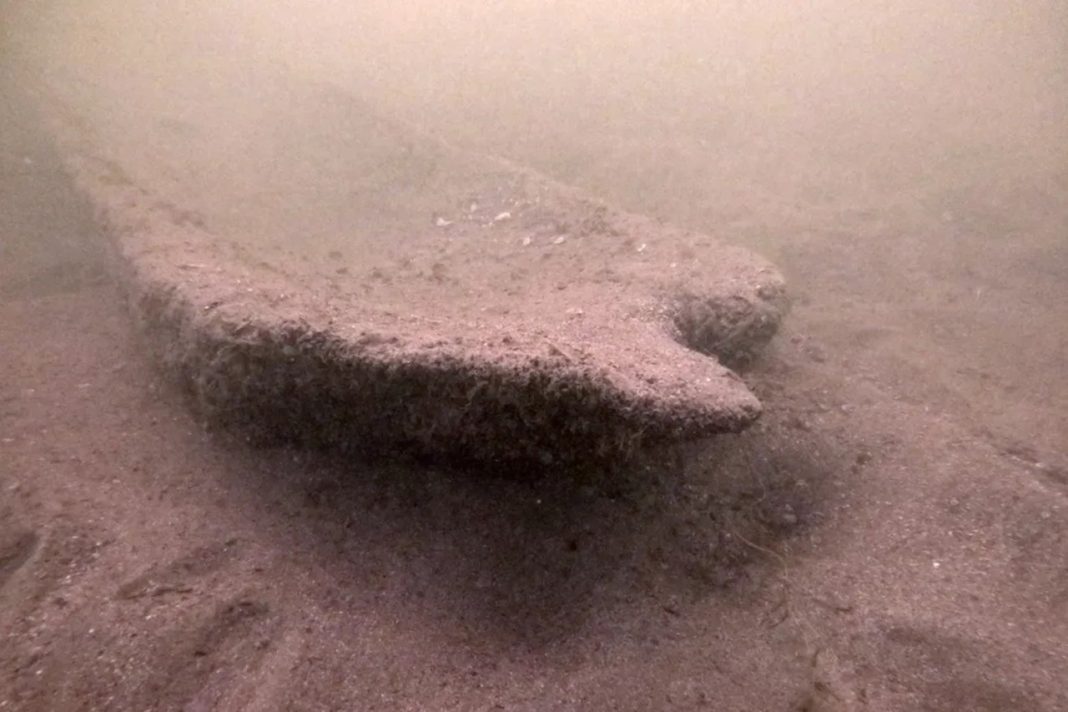

A routine volunteer dive to remove trash from a Wisconsin lake turned into an extraordinary archaeological discovery when a diver spotted a wooden canoe resting underwater. Radiocarbon testing revealed that the vessel dates back roughly 1,000 years, offering a rare glimpse into Indigenous history, ancient craftsmanship and life around Wisconsin’s lakes centuries ago.
A Volunteer Trash-Cleanup Dive Led to an Unexpected Archaeological Discovery

Sometimes, an ordinary cleanup effort can uncover a piece of history that has remained hidden for centuries. That is exactly what happened to Mark Schachtner, a 45-year-old diver from Beaver Dam, Wisconsin, while he was participating in a volunteer cleanup in Pewaukee Lake on May 6, 2026. Schachtner had spent about a decade diving in southeastern Wisconsin lakes, often searching for old glass bottles and other objects on lake beds. As he was nearing the end of his dive, he noticed an unusually long object resting underwater. A closer look revealed what appeared to be an ancient dugout canoe. Recognizing that the discovery could be significant, he recorded its location and contacted Tamara Thomsen, a maritime archaeologist with the Wisconsin Historical Society. Her team subsequently examined the vessel, collected a small wood sample and confirmed its remarkable age through scientific testing. What began as an effort to remove rubbish from the lake had unexpectedly brought an important piece of Indigenous history to light.
Radiocarbon Dating Places the Canoe Between 992 and 1049 CE

The canoe’s age is more than an educated guess. Archaeologists relied on radiocarbon dating to establish when the wooden vessel was likely made and used. Testing conducted by Beta Analytic, a laboratory in Miami, found a 70% chance that the canoe dates to between 992 and 1049 CE, placing it roughly 1,000 years in the past. The Wisconsin Historical Society received the results in August 2026, alongside findings identifying the wood as white oak. Radiocarbon dating estimates the age of organic materials by measuring the remaining carbon-14 in a sample and comparing it with expected levels over time. Although the results provide a strong estimate, the 70% probability is important because it does not establish an exact year with complete certainty. The date places the canoe in the Late Woodland period, a significant era in Wisconsin’s Indigenous history. Archaeological evidence from this period helps researchers understand how communities lived, traveled, traded and obtained food long before modern settlements transformed the region.
The 17-Foot Vessel Was Carved From White Oak

Despite spending approximately a millennium underwater, the canoe remains remarkably intact. Measurements taken by Thomsen and Schachtner revealed that the vessel is about 17.3 feet long and 1.8 feet wide at its thickest point. Its walls measure approximately 2.5 inches thick, while the bottom is around 4.8 inches thick. Researchers identified the material as white oak, a durable hardwood that was also used in other ancient dugout canoes discovered in Wisconsin. The vessel is partially filled with sediment, which may have helped shield parts of the wood from damage. Its survival is especially notable because submerged archaeological objects can deteriorate when exposed to changing environmental conditions. Waterlogged wood may lose its structural integrity if it dries too quickly, making recovery and conservation complicated and expensive. The canoe’s present condition gives archaeologists an opportunity to study its construction and understand how Indigenous craftspeople worked with locally available materials. Its measurements and visible features also allow researchers to compare it with other dugout canoes found across the state.
Indigenous Communities Used Fire and Hand Tools to Shape the Canoe

Creating a canoe from a single tree trunk required considerable time, patience and practical knowledge. Archaeologists examining the Pewaukee Lake vessel observed marks suggesting that its makers used fire to help shape the wood, along with scraping techniques associated with stone tools or shells. Ho-Chunk Nation President Jon Greendeer explained that traditional canoe construction involved substantial labor, reflecting the skill required to transform a large tree into a functional watercraft. Craftspeople needed to understand how wood responded to heat and how to remove material without weakening the finished vessel. Fire could help char and soften portions of the wood, while scraping and other hand techniques helped refine its shape. The exact tools and steps used to create this particular canoe have not been conclusively established, so researchers are interpreting the available evidence rather than claiming to know every detail of its construction. Nevertheless, the visible marks offer a valuable glimpse into Indigenous engineering and craftsmanship. They also demonstrate that people living in the region possessed the knowledge needed to build durable boats suited to their local waterways.
The Canoe May Have Been Deliberately Sunk for Seasonal Storage

Finding an ancient canoe resting on a lake bed might seem unusual, but archaeologists believe its position could reflect a deliberate storage practice rather than an accident. Tamara Thomsen noted that the vessel’s condition and its partial covering of sediment resemble other canoes that Indigenous communities intentionally submerged for safekeeping. According to her explanation, people sometimes placed their canoes underwater and allowed sediment to accumulate inside them, returning later to retrieve and dry the vessels before using them again. The canoe may have been positioned near an ancient shoreline that existed when the water level and landscape differed from those of today. If that interpretation is correct, the location could represent a practical storage site used by people who depended on the lake for transportation and daily activities. Researchers have not established precisely why this particular canoe was left there, so seasonal storage remains a well-supported possibility rather than a confirmed explanation. Even so, the discovery offers an intriguing reminder that an object appearing abandoned today may have served a perfectly practical purpose in the past.