
Something bright is coming to a very visible corner of downtown Minneapolis. And the real story is bigger than the artwork itself.
What’s happening at 800 Washington Avenue S is a snapshot of how public art, neighborhood politics, and practical city-making can actually work together when the timing is right.
A long-watched downtown site is finally getting a new look
For people who live, work, or spend time in the Mill District, 800 Washington Avenue S has been one of those places that always felt like it should be doing more. It sits in a high-profile stretch of downtown, near some of Minneapolis’ best-known civic and cultural destinations, yet it has remained an underused property while larger redevelopment plans continue to evolve. That kind of vacancy can make a block feel unfinished, especially in a neighborhood where street-level activity matters.
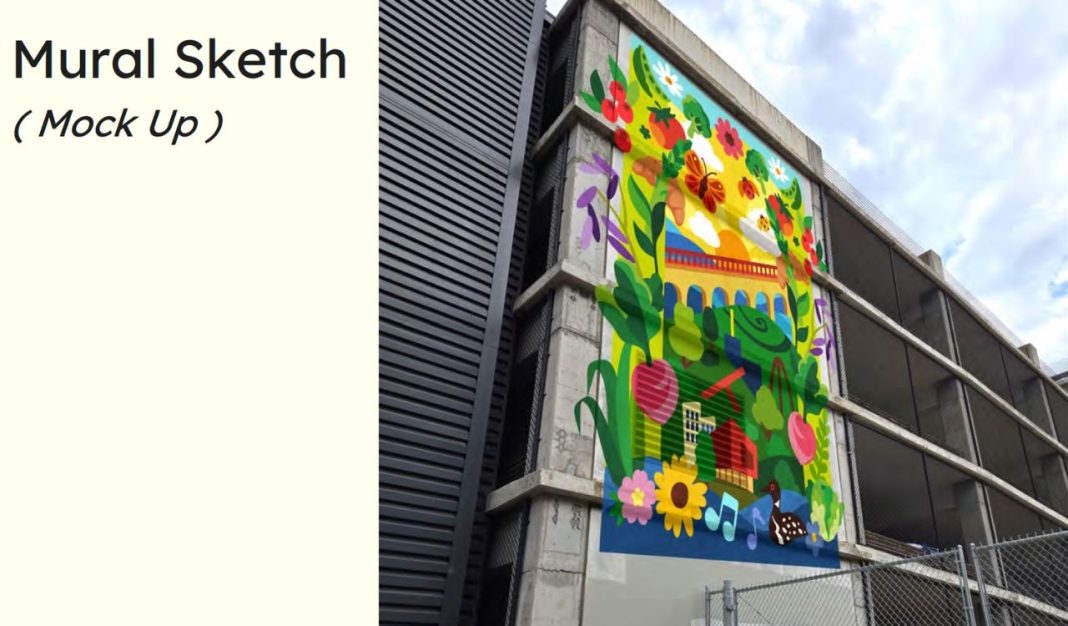
Now the Downtown Minneapolis Neighborhood Association, working with Sherman Associates, is moving ahead with a new installation called Mill City in Bloom. According to the neighborhood association, the project has already received city approvals and is scheduled for installation this fall, with fabrication and installation support from Blackbird Revolt and Sharp Sign Co. and artwork by local artist Tiana Nguyen. Sherman Associates is providing financial support for the project, making this a rare case where a private development partner is helping fund a highly public-facing interim improvement.
That matters because interim-use projects often get stuck in the gap between good intentions and actual execution. Plenty of neighborhoods talk about activating vacant land, but fewer get to the point of final approvals, identified partners, and a visible timeline. In this case, the concept moved from a community idea to something concrete, and that alone says a lot about how seriously the partners treated what residents asked for.
There is also a symbolic layer here. Downtown Minneapolis has spent the past several years trying to redefine what a healthy central city looks like beyond office traffic and conventional redevelopment cycles. Small-scale public projects, especially ones that make blank spaces feel intentional again, can play an outsized role in that effort. They do not replace long-term development, but they can prevent a site from reading as stalled or forgotten.
In other words, Mill City in Bloom is not just decoration. It is an urban placeholder with personality, a neighborhood signal that says this corner still matters right now, not only when a future building eventually rises there.
The project started with a basic question: what should this lot do for the neighborhood?
The backstory is what makes this installation especially interesting. In 2025, the DMNA Land Use Committee launched an Interim Use Survey asking residents and other downtown stakeholders what they wanted to see at the vacant 800 Washington Avenue property while it awaited future redevelopment. More than 200 people responded, and residents made up the largest share of participants. The results showed broad interest in making the property more useful in the meantime rather than leaving it as dead space.
The ideas people supported were telling. According to DMNA, respondents were interested in green space, a native pollinator garden, pop-up markets and food trucks, community gardens, and public art installations. That mix says a lot about what downtown residents increasingly value: places that feel social, local, flexible, and visually alive. Instead of one single grand solution, the survey pointed toward uses that could soften the site, invite foot traffic, and make the neighborhood feel more participatory.
That survey also reflects a broader shift in urban planning culture. Temporary use is no longer seen as a consolation prize while “real” development waits in the wings. In many cities, interim projects are treated as legitimate public-realm tools that can test ideas, build community ownership, and improve safety and perception. Minneapolis has leaned into that logic before, and in this case it gave neighbors a structured way to say: if the site cannot be fully built out yet, it should still contribute something.
After the survey, Mill City Farmers Market and Sherman Associates connected with DMNA to explore what could realistically be done. Those conversations helped narrow a wide menu of community wishes into an installation that could be produced, approved, and maintained. Mill City Farmers Market then helped connect the project team with local artists and supported additional community engagement around the early design concept during the summer.
That chain of events is easy to underestimate, but it is exactly how many successful neighborhood projects happen. A survey creates legitimacy, a property stakeholder helps with feasibility, and a trusted community institution bridges the gap between abstract support and an artist-led concept. By the time Mill City in Bloom emerged, it was not a top-down surprise. It was the result of a fairly visible civic conversation.
Mill City in Bloom is designed to feel local, optimistic, and unmistakably Minneapolis
So what will people actually see? DMNA describes Mill City in Bloom as a celebration of Minneapolis as a place where nature, culture, and community grow together. The design draws from the Mississippi River, urban gardens, music, public spaces, neighborhood life, botanical forms, pollinators, local landmarks, and thriving landscapes. At the center of the concept is a simple phrase: “We Love Our City.”
That design language is not random. In the Mill District, river identity and industrial history sit right next to residential growth, farmers market culture, and a strong appetite for public space that feels welcoming rather than overly formal. A botanical and pollinator-driven visual approach gives the installation a sense of softness and motion, which can be especially effective on a hard-edged urban site. It also echoes what survey respondents said they wanted: more greenery, more life, and more reasons for a space to feel inhabited even when it is not occupied by a building.
The involvement of local artist Tiana Nguyen is important here too. Public art tends to land better when it feels rooted in local visual culture instead of parachuted in from a generic civic playbook. Even when an installation is cheerful and broadly accessible, it still needs a point of view. The strongest neighborhood art projects are usually the ones that look like they belong to a particular place and could not have been dropped unchanged into any other city.
There is also a strategic communications dimension to a phrase like “We Love Our City.” Downtown Minneapolis has spent years under a national microscope for reasons ranging from pandemic-era office disruption to public safety concerns to shifting investment patterns. A confident, outward-facing public artwork does not solve those structural issues, but it can push against a narrative of decline. It says that residents and local institutions are still investing emotionally in downtown’s identity.
And that, really, is part of the installation’s job. It is meant to bring color and energy to a prominent site, yes, but also to remind people that civic affection is visible. A neighborhood can show pride not only through major construction or marquee events, but through the smaller act of refusing to leave an important corner blank.
Minneapolis has been leaning into public art, and this project fits a bigger local pattern
Seen on its own, Mill City in Bloom is a neighborhood-scale installation. Seen in context, it is part of a larger Minneapolis moment in public art, one that spans everything from murals to immersive riverfront works. Earlier in 2026, for example, Boom Island Park hosted the U.S. debut of Saype’s Beyond Walls, a temporary large-scale land-art project made with biodegradable materials and known for its intertwined-hands imagery. That work was unveiled along the Mississippi riverfront and framed as a symbol of connection, resilience, and shared public experience.
The comparison is useful because it shows the range of what public art can do in Minneapolis right now. Saype’s project was temporary, monumental, and internationally recognized, built around spectacle and symbolism. Mill City in Bloom is more neighborhood-specific and more closely tied to a single underused site. But both projects rely on a similar idea: public art can transform how people move through a place, talk about it, and understand its meaning, even if the artwork itself is temporary or interim.
That has become increasingly relevant in downtowns everywhere. Cities are looking for ways to make central districts feel active beyond business hours, and visual interventions are one of the fastest tools available. Unlike a full capital project, an art installation can happen on a shorter timeline, involve local partners, and generate a sense of novelty without requiring years of construction. It can also create a softer entry point for public participation, especially for people who are more likely to respond to beauty than to a zoning agenda.
Minneapolis is particularly suited to this approach because so much of its civic identity is tied to design, parks, waterways, and creative culture. In that environment, public art is not just frosting. It is part of how the city narrates itself. Whether the project is global in scale or hyperlocal in focus, the message is similar: public space should communicate something.
That is why Mill City in Bloom lands at the right time. It joins a broader conversation about how Minneapolis wants its shared spaces to feel in 2026: more expressive, more local, and more obviously cared for.
What happens next could matter almost as much as the installation itself
The installation is expected this fall, but the more interesting question may be what follows once it is in place. DMNA has said it looks forward to sharing more information about the completed installation and a future community celebration, suggesting that the project is not being treated as a one-and-done visual upgrade. The celebration piece matters because the most successful public artworks often become occasions as much as objects. They give neighbors a reason to gather, not just something to pass by.
There is also a practical test embedded in this project. If Mill City in Bloom succeeds in drawing attention, improving the site’s atmosphere, and giving residents a sense of ownership, it may strengthen the case for more ambitious interim-use thinking on other underutilized downtown parcels. Minneapolis has no shortage of spaces caught between past plans and future proposals. A well-executed project at 800 Washington could serve as a model for what happens when community input is translated into something visible instead of being filed away.
For Sherman Associates, there is likely value in that too. The company has a long history in Minneapolis development, and 800 Washington has been part of redevelopment conversations for years. Supporting a public-facing interim art project allows the developer to stay engaged with the neighborhood in a way that is tangible, relatively immediate, and aligned with what residents said they wanted. That does not erase bigger debates about land use, but it does build goodwill through action.
For downtown residents, though, the takeaway is simpler. A prominent lot that could have remained inert is getting color, story, and a public message shaped by local input. That is not trivial. In a city center still defining its next chapter, these smaller acts of reinvention can change how a block feels week to week and how a neighborhood imagines itself over time.
So yes, downtown Minneapolis is getting a new public art installation. But the real story is that neighbors asked for more from a vacant site, local groups kept pushing, and the city is about to get a reminder that even interim spaces can make a lasting impression.