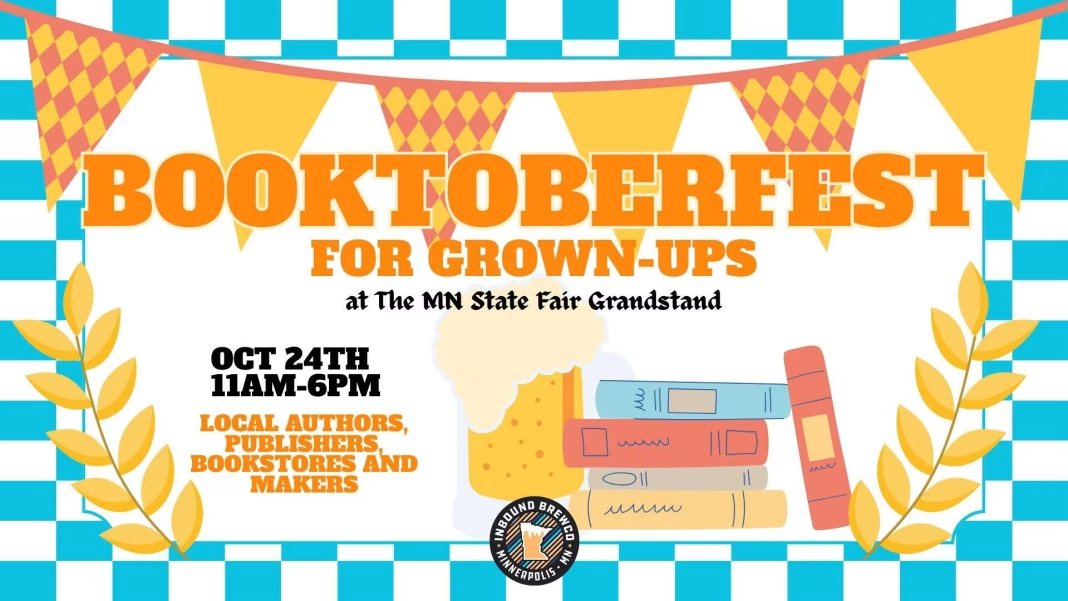

Autumn has become prime season for literary gathering in Minnesota. This Saturday, October 24, 2026, the state fairgrounds will host a book event that treats reading not as a solitary pastime, but as a public celebration.
Booktoberfest for Grown-Ups arrives at the Minnesota State Fair Grandstand with the scale of a trade fair and the atmosphere of a neighborhood festival. With more than 200 exhibitors expected, the event offers a revealing snapshot of how contemporary book culture is evolving.
A literary fair built for adult readers
Booktoberfest for Grown-Ups is scheduled for Saturday, October 24, 2026, at the Minnesota State Fair Grandstand, with VIP entry beginning at 11:00 a.m. and general admission running from 1:00 p.m. to 6:00 p.m. Event listings describe it as a one-day gathering of local authors, bookstores, publishers, makers, food vendors, and related exhibitors. Organizers have framed the fair as both a marketplace and a seasonal social outing, encouraging visitors to “stock up for the winter” while enjoying a festival environment shaped by bonfires, beverages, and casual browsing.
The event’s ticketing structure underscores its ambition to attract multiple types of visitors rather than a narrow literary niche. Advance prices list VIP admission at $20, general admission at $10, and afternoon admission at $5, while children 12 and under are admitted free. Organizers have also emphasized early check-in procedures and multiple entry points, an operational detail that suggests expectations of substantial attendance and a desire to reduce bottlenecks before visitors move into the main fair space.
What makes the event especially notable is its scale. Listings from the event page, local tourism promotion, and participating booksellers all point to a roster of more than 200 exhibitors, a figure large enough to place the fair well beyond the category of a modest author market. In practical terms, that number signals breadth: readers are likely to encounter not only books for sale but also presses, specialty retailers, handmade goods, and genre-centered displays that turn browsing into an exploratory experience rather than a simple shopping trip.
The “for grown-ups” framing is also worth taking seriously. It is clearly playful, invoking the nostalgia of childhood school book fairs, yet it points to a deeper cultural logic. Adult readers are being invited back into an immersive retail-literary environment that many associate with formative reading experiences. In that sense, the fair is not merely selling books; it is reviving a structure of discovery, surprise, and abundance that digital recommendation systems often flatten.
Why Minnesota is fertile ground for a book event of this size
Minnesota has long sustained a literary infrastructure disproportionate to its population size. The Twin Cities support independent bookstores, active reading communities, nonprofit literary organizations, university presses, writing programs, and a dense calendar of author talks and festivals. That civic ecology matters because large book fairs do not emerge in a vacuum. They depend on a region where books are not only consumed but publicly discussed, institutionally supported, and commercially distributed through channels beyond national chains.
One of the clearest indicators of this environment is the continued prominence of the Twin Cities Book Festival, presented by Rain Taxi, which has described 2026 as its twenty-sixth consecutive year. That longevity demonstrates that literary gatherings in Minnesota can achieve durability when they align readers, publishers, booksellers, and cultural organizations around a common public purpose. Booktoberfest is not the same event, and it appears to occupy a more explicitly commercial and lifestyle-oriented niche, but it benefits from the same broader ecosystem of literary participation.
The Minnesota State Fairgrounds also provides a symbolically potent venue. The fairgrounds are already associated with mass attendance, seasonal ritual, and a distinctly Minnesotan mode of public gathering. By placing a literary event in the Grandstand, organizers borrow some of that cultural energy. The result is a reframing of reading culture: books are moved out of the quiet enclosure of the bookstore and into one of the state’s most recognizable spaces of communal leisure.
That choice may also prove commercially intelligent. Book buyers who might not attend a conventional literary conference can be attracted to a setting that feels open, festive, and familiar. The state fair model encourages lingering, grazing, and incidental discovery. For exhibitors, that matters. Independent bookselling often depends on exactly the kind of serendipitous encounter such events produce: a passerby spots an unfamiliar cover, speaks with an author, samples a genre they do not usually read, and makes an unplanned purchase that would likely never occur in an online cart.
The exhibitor mix reveals a changing literary marketplace
The headline number, more than 200 exhibitors, matters not simply because it is large, but because it signals heterogeneity. Event descriptions and exhibitor materials indicate that the fair will include authors, bookstores, publishers, local makers, and food-related vendors. That composite structure reflects a broader transformation in literary commerce, in which the sale of books increasingly overlaps with gift culture, artisanal production, fandom, and event-based consumption. Reading, in other words, is being packaged as an experience as much as a transaction.
Genre breadth is central to that strategy. Organizers say the fair will represent BIPOC literature, biography and memoir, children’s books, cookbooks, dystopian fiction, fantasy, graphic and comic work, historical fiction, history, horror, literary fiction, LGBTQIA+ titles, mystery and thriller, pop culture, romance, science fiction, self-help, used and rare books, westerns, and young adult literature, among others. Such range broadens the audience while also acknowledging how fragmented contemporary reading publics have become. A successful modern book fair must function less like a canon-driven salon and more like a many-laned cultural marketplace.
That diversity of categories carries practical implications for exhibitors. Independent presses can reach readers looking for discovery outside the algorithmic mainstream. Used and rare sellers can serve collectors. Romance, fantasy, horror, and comics exhibitors can capitalize on intensely loyal fan communities that often respond enthusiastically to in-person merchandising. Makers, meanwhile, can sell adjacent goods that turn literary enthusiasm into material culture: prints, candles, apparel, bookmarks, and themed accessories that express identity as much as taste.
There is also a subtle but important economic point here. For small-scale book businesses, events like this compress customer acquisition into a few high-density hours. A bookstore or author may spend weeks or months trying to generate equivalent foot traffic through ordinary channels. In a fair setting, however, discovery is accelerated. Conversations happen face to face, books can be handled immediately, and purchasing decisions are often made on affective grounds. The fair thus becomes a temporary but highly efficient infrastructure for independent literary commerce.
More than a book sale: the rise of the literary lifestyle event
Booktoberfest is not being marketed as a conventional retail fair. Event descriptions emphasize craft beer from Inbound BrewCo, hard cider, nonalcoholic options, food trucks, cozy spaces, and bonfires. These are not incidental amenities. They are part of the event’s central design, helping translate book browsing into a social ritual comparable to a food market, seasonal festival, or maker fair. The contemporary literary event increasingly succeeds when it understands itself as hospitality as well as culture.
This format reflects a wider shift in consumer behavior. Audiences now frequently seek hybrid outings that combine shopping, entertainment, and atmosphere. A books-only event can thrive, but a books-plus-environment event may draw a broader public. The fair’s appeal therefore lies not just in what is being sold, but in how the day is staged. A visitor might come for a drink with friends, wander into a genre section out of curiosity, and leave carrying several books. Cultural participation becomes porous rather than specialized.
There is an academic dimension to this trend as well. Scholars of cultural consumption have long argued that taste is enacted socially, not merely privately. Booktoberfest offers a concrete example. Readers are not only purchasing texts; they are performing affiliation with local culture, independent commerce, and a lifestyle organized around curiosity and discernment. The fire pits and beverage stations may seem peripheral, yet they help create the conditions under which literary identity becomes visible and shareable.
At the same time, the fair’s festive design may help counter a common misconception that reading culture is exclusionary or austere. By making the atmosphere casual and sensory, organizers widen the threshold of entry. Someone who does not think of themselves as deeply “literary” may still feel welcome. That has long-term implications. Events that lower intimidation barriers can cultivate future bookstore customers, repeat festivalgoers, and more active participants in local arts ecosystems.
What the event could mean for readers, booksellers, and the region
For readers, the immediate value of the fair lies in concentration. In a single afternoon, attendees can encounter hundreds of vendors, multiple genres, and a cross-section of Minnesota’s literary and maker communities. That density is increasingly rare in an era of dispersed digital consumption. Browsing online offers abundance, but not texture. A fair reintroduces materiality: cover design, table display, spontaneous conversation, and the persuasive authority of a bookseller or author speaking directly about a work.
For booksellers and publishers, the event functions as both revenue opportunity and branding exercise. Sales matter, especially for independent businesses facing pressure from online retail consolidation, changing consumer habits, and rising operating costs. Yet visibility matters too. A strong showing at a fair can create later store visits, newsletter sign-ups, social media followings, wholesale relationships, and word-of-mouth recognition. In that sense, one Saturday at the Grandstand may yield effects extending far beyond the event itself.
For authors, especially regional and independent writers, these events remain unusually valuable. They offer not only the possibility of direct sales but also a chance to meet readers outside formal launch settings. That interaction can be crucial for midlist and emerging writers whose work benefits from hand-selling and personal introduction. Literary reputation often appears abstract from a distance, but on the ground it is built in conversations, inscriptions, recommendations, and moments of recognition at tables crowded with competing titles.
More broadly, Booktoberfest illustrates how regional cultural economies are adapting rather than retreating. The future of book culture is not solely digital, nor is it simply nostalgic. It is increasingly event-driven, local, multisensory, and collaborative across sectors. A fair that combines over 200 exhibitors with books, makers, food trucks, beverages, and seasonal ambience is not a gimmick so much as a contemporary answer to a serious question: how do communities keep literary life public? In Minnesota this Saturday, one answer will be visible in the Grandstand aisles.