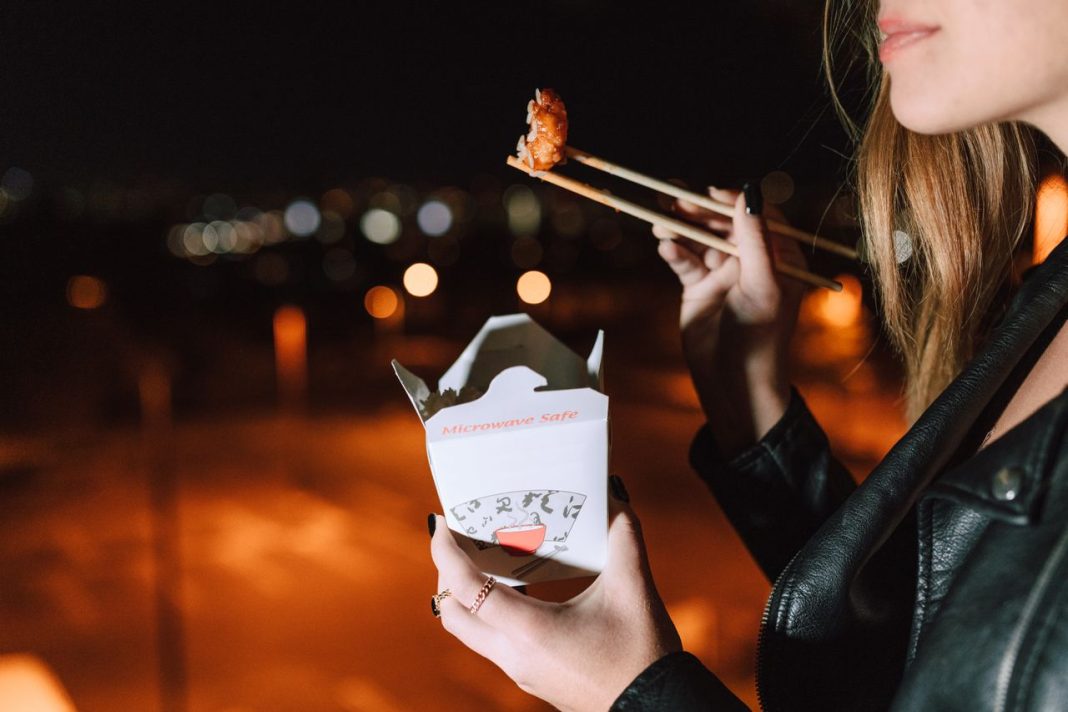

Few food containers are as instantly recognizable in the United States as the folded white takeout box with a wire handle and red pagoda. Yet the object most Americans associate with noodles and fried rice began its life carrying something entirely different: oysters.
That transformation was not accidental. It emerged from late 19th-century packaging innovation, the growth of Chinese American restaurants, and the rise of convenience as a defining feature of modern eating.
The box began as a practical answer to an oyster problem
The container now known as the Chinese takeout box originated as a paper pail in the 1890s, at a time when oysters were a mass-market food in the United States. Before refrigeration and modern plastics, vendors needed a vessel that could hold wet, irregular food securely, travel reasonably well, and cost little to produce. The answer came from folded paper engineering rather than from ceramic crocks or metal tins.
In 1894, Frederick Weeks Wilcox of Chicago received a U.S. patent for what he described as an improved paper pail. Patent records show that Wilcox’s design used a single piece of foldable material arranged to create structural strength while reducing leakage, an elegant solution for transporting shellfish and other moist foods. A related Wilcox patent from the mid-1890s further developed the folded box form, underscoring that this was not a novelty item but part of a serious packaging effort aimed at everyday commerce.
The logic of the design remains striking even now. The folded walls create rigidity without requiring elaborate assembly, while the top flaps function as both closure and lid. The attached handle made the pail easy to carry, especially in urban markets where shoppers often traveled on foot. In other words, the box solved several logistical problems at once: containment, portability, stackability, and low manufacturing cost.
Its original association with oysters also tells us something important about American food history. Oysters in the 19th century were not merely luxury fare; in many cities they were abundant, affordable, and widely consumed. A container optimized for oysters therefore served a large commercial market. What later generations would read as a distinctly ethnic food package was, in origin, simply an American solution to the demands of a fast-moving urban food economy, as accounts from the Associated Press and patent records both make clear.
Chinese American restaurants gave the paper pail a new identity
If the oyster pail was invented for one food economy, it found its lasting fame in another. Chinese immigrants began arriving in significant numbers in the United States in the mid-1800s, participating in the Gold Rush, railroad construction, and urban labor markets. In the Chinatowns that formed in San Francisco and other cities, restaurants became important community institutions and, eventually, major points of cultural exchange between Chinese immigrants and non-Chinese diners.
Over time, a specifically American style of Chinese restaurant cuisine took shape. Dishes were adapted to local ingredients, customer expectations, and the economics of restaurant service. By the mid-20th century, what many Americans called “Chinese food” had become one of the country’s most common and affordable restaurant cuisines. Historians interviewed by the Associated Press note that after World War II, Chinese restaurants expanded well beyond the earlier chop suey and chow mein model, helping fuel a broad national appetite for takeout.
That expansion mattered because Chinese restaurants were unusually well positioned to benefit from portable packaging. Their menus often featured foods that could be portioned quickly, packed in quantity, and eaten later without losing all appeal. The paper pail’s shape worked especially well for sauced dishes, rice, and noodles. It was inexpensive, recognizable, and serviceable for delivery and pickup long before the modern app economy made off-premises dining routine.
At some point, then, the container ceased being merely a neutral package and became identified with a cuisine. The shift was cultural as much as practical. According to reporting echoed across NBC and ABC affiliates carrying the Associated Press story, Chinese restaurant owners sought to project accessibility, abundance, and convenience. The pail fit that ambition perfectly. It allowed restaurants to sell not only a meal but also an experience of ease: food ordered quickly, carried home easily, and shared with little fuss. A generic American paper container had been absorbed into the visual language of Chinese American dining.
Design, branding, and stereotype shaped the box Americans remember
The carton’s most familiar visual features were not part of the original 19th-century design. The classic white box with a red pagoda and the words “Thank You” in stylized lettering appears to have become widespread only in the 1970s, when the packaging company then known as Fold-Pak introduced graphics that linked the container more explicitly to Chinese restaurant food. By then, the folded pail was already in use, but branding helped turn a practical object into a cultural icon.
That distinction matters. Without the printed imagery, the box is simply a paperboard container with a clever geometry. With the imagery, it becomes a sign. Consumers no longer saw only packaging; they saw “Chinese takeout.” Michelle King, a historian of China cited in Associated Press coverage, describes this as the moment when the object became claimed as a Chinese American food item in the public imagination, in much the same way other packages came to stand for other cuisines.
Yet the branding also reflected a broader American habit of reducing complex cultures to simplified symbols. The pagoda graphic and pseudo-calligraphic typography were meant to be evocative, but they depended on a stereotyped East Asian visual vocabulary. They did not emerge from Chinese culinary tradition in China, nor did they accurately represent the diversity of Chinese American restaurant culture. Instead, they functioned as commercial shorthand, translating ethnicity into packaging in a way that felt legible to mainstream consumers.
This is one reason the carton is such a revealing artifact. It condenses admiration, convenience, misrecognition, and assimilation into a single object. It celebrates Chinese food’s place in American life while also exposing how immigrant cuisines are often marketed through caricature. The takeout box is therefore not just a package but a historical document of American consumer culture. Even its decoration tells a story about who was being addressed, what they were expected to recognize, and how ethnicity was stylized for mass-market appeal.
Convenience culture made the container an American classic
The rise of the takeout box cannot be separated from the rise of takeout itself. In the second half of the 20th century, American eating habits shifted toward convenience, portability, and food consumed outside formal dining rooms. Families wanted meals that could be picked up after work, shared at home, or served casually at gatherings. Long before food delivery apps, Chinese restaurants had become masters of this mode of service.
The oyster pail was unusually well suited to that environment. It occupied little storage space before folding, kept costs manageable for restaurant operators, and offered enough structural integrity to survive the trip from kitchen to customer. It also had one underappreciated advantage: once opened, the top flaps could turn the container into a makeshift plate or bowl. That practical adaptability helped cement its popularity among diners, office workers, and students alike.
Its reach extended well beyond Chinese food. As food writers have noted, the same style of container has been used for all kinds of cuisines and snacks, from rice dishes to desserts. But Americans continued to read it primarily through the lens of Chinese takeout because restaurant culture, film, television, and urban routine had already fixed that association. Packaging became memory, and memory became iconography.
Museums and food historians have treated the container seriously for precisely this reason. The Smithsonian’s National Museum of American History has included Chinese takeout containers in exhibitions on the history of Chinese food in the United States, recognizing that everyday objects can reveal broad patterns of migration, consumption, and identity. What looks disposable turns out to be historically dense. The carton captures the making of an American cuisine category, the expansion of urban food service, and the larger national turn toward meals built around speed and portability rather than ceremony.
The takeout box endures because it tells a larger American story
Today, many restaurants use plastic tubs, compostable clamshells, or other paperboard containers better suited to soupier dishes, delivery stacking, and contemporary environmental requirements. Even so, the old oyster pail remains visually dominant in the American imagination. It persists in advertising, emoji design, film sets, and nostalgic depictions of city life. That endurance is not just about function. It is about symbolism.
The box survives because it embodies several overlapping American narratives at once. It represents inventive industrial design from the 1890s, immigrant entrepreneurship in the restaurant trade, and the mainstreaming of Chinese American food after World War II. It also reflects the ability of commerce to transform an ordinary package into a nationally recognized emblem. Few containers have done so much cultural work while appearing so modest.
There is also an irony at the center of its history. The object most Americans think of as quintessentially “Chinese” is, in fact, a distinctly American hybrid: invented in Chicago, adapted through U.S. restaurant culture, and visually branded through American commercial expectations. Its story demonstrates how national food identities are often assembled from unexpected parts. Cuisine is not only what is cooked; it is also how it is boxed, carried, sold, and imagined.
Seen this way, the Chinese takeout box is less a relic of novelty than a case study in cultural formation. A vessel devised for oysters became a symbol of Chinese American food because it met the needs of restaurants and the desires of customers at exactly the right historical moment. That is why the box still matters. It reminds us that even disposable things can acquire durable meaning, especially when they sit at the intersection of technology, migration, and appetite.